How to Not Get Things Done on a Team
Published on: October 22, 2026
min read
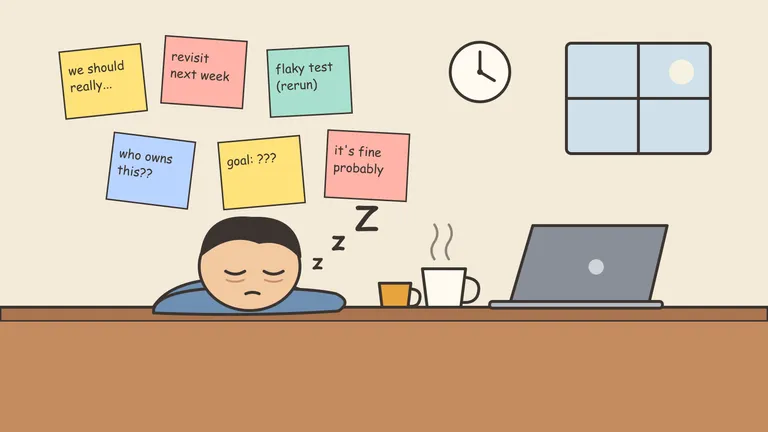
Table of Contents
Short version: have no goal, stay quiet, don’t trust people, don’t decide, get comfortable, don’t close the loop.
Most of this is obvious when we read it, and easy to forget when a deadline is close. So here’s how to not get things done, written down so I deliberately remember what to avoid.
Having no goal
“What are we working on this quarter?” “Uh… a few things.”
Without a shared goal, there’s nothing to prioritize against, nothing to decide against, and no reason to hurry. Every other mistake on this list gets easier. Often we’re not sure what the goal should be, so we avoid picking one. But a rough goal we can change later beats no goal at all.
“This quarter we’re cutting onboarding from two weeks to three days. Anything that doesn’t help with that can wait.”
Staying quiet
“Yeah, the deploy test is flaky, just rerun it.”
“So… the migration isn’t going to make it.” (one week before the deadline)
Hope doesn’t do any work. There’s an old SRE saying, “Hope is not a strategy”, and it applies to people problems as much as outages. A problem nobody raises doesn’t go away. It grows, and a concern in week one is far cheaper than a surprise in week four.
Staying quiet is rarely a personal flaw. Sometimes it’s inertia: raising a problem takes effort, and staying quiet takes none. Sometimes speaking up feels risky, and if people think they’ll be judged for raising a concern or admitting a mistake, the sensible move is to keep quiet and hope. Sometimes there’s just no obvious place to say it, or we’re not sure it’s really a problem yet. So it helps to make a small, boring place for it, like a team channel or a “known issues” list, where raising something takes ten seconds and doesn’t feel like an announcement. How we react matters too. If the first person to raise a problem gets a sigh, the next person won’t.
“Heads up: the migration is a week behind because the old data is messier than expected. We can still make the date if we drop reporting. Can we decide by tomorrow?”
And if we decide not to fix something, it helps to write that down as a decision, so it doesn’t just drift.
Not trusting people
“Use this library, structure it like this, and ping me after each step.”
“Here, let me just do it, it’ll be faster.”
Hovering tells people we don’t trust them and makes us the bottleneck. Once people know we’ll redo it anyway, they stop thinking for themselves. Taking work back does the same thing more quietly. It is faster this time, but now they’ve learned that getting stuck gets them rescued, and next time they’ll come to us sooner.
Both usually come from fear of losing control, or from never defining what good looks like, so we feel we have to watch everything. The opposite mistake is just as real: “can you handle login?” and then disappearing. Andy Grove’s point is that how much support someone needs depends on the task, not just the person. A senior engineer doing something new still needs more support than a junior doing something they’ve done ten times. It’s hard to get this right, and it’s easy to miss in both directions. Defining the outcome clearly makes it easier:
“We need SSO working for beta customers by the 15th, with no new paid services. How you build it is up to you. Let’s check in Wednesday.”
When someone is stuck, we can help them think it through without taking it over. If it really is urgent and we take it, walking them through it afterwards means next time they can do it themselves.
Nobody decides, nobody owns
“Let’s gather more data and revisit next week.”
“We should really update the onboarding docs.”
Sometimes it’s fear. If we decide and it fails, it’s ours, but if nobody decides, the blame spreads out and lands on “circumstances.” More often it’s just inertia. The task has no obvious first step, nothing about it is urgent, and doing nothing costs no effort. Nobody chose to drop it. It just never got picked up. And when everyone could do it, nobody does, because each person assumes someone else will.
We’ll rarely feel sure. But most decisions can be reversed, and being slow often costs more than being slightly wrong. Bezos separates one-way doors, which are hard to undo and deserve care, from two-way doors, which are easy to undo and deserve speed, and suggests deciding with about 70% of the information you’d like. When something is stuck, a better question than “why is nobody doing this?” is “what’s the smallest thing someone could do today, and who?” One name and one date can feel blunt, but it’s kinder than leaving it vague.
“We’ve debated this for two weeks. Going with Postgres, and we can revisit if it doesn’t fit. Ana, can you set up the schema by Friday?”
If we disagree with where the team landed, we can say so once, then commit and help it work.
Getting comfortable
“Yeah, releases are slow, they’ve always been like that.”
Sometimes there’s no fear and no blame, and still nothing happens. Nobody is rude and nothing is on fire, and months go by with the same problems in the same state. From the inside, it doesn’t feel like a problem, so it’s hard to notice in ourselves.
Kotter’s point is that this often follows success. Once things have worked for a while, urgency fades and attention turns inward, and without a customer, a deadline, or a competitor pushing, a slow decline never feels like an emergency. Politeness makes it worse. When disagreeing feels rude, people nod along and keep their concerns to themselves. And some people have learned not to bother: if you raised something twice and nothing happened, you stop raising it.
What helps is bringing in some outside reality and changing one small, visible thing, so people can see that things can move:
“Releases took 3 days on average last quarter, and two customers complained. I’ll try skipping manual QA for small changes for the next two releases.”
When someone does raise something, an answer matters, even if it’s “not now, because X.” Being told no is better than being ignored. Frantic busyness isn’t the fix either, though. It just replaces comfort with a different problem.
Not closing the loop
The ticket closes. Nobody says anything.
Finished work that nobody acknowledges or learns from might as well not have happened. People notice when their work vanishes without comment, and they volunteer less next time. Good teams make a point of thanking people visibly, and share what they learned so the next person doesn’t repeat it.
“Migration’s done. Thanks Sam, that was messy data and you handled it well. Lesson for next time: sample the data before estimating.”
The test
A simple way to check all of this: could we disappear for two weeks and have things keep moving? If the team knows the goal, raises problems, makes decisions, and owns its work, it will. If everything waits for us, something above is missing.
Real teams aren’t this tidy. Goals shift, people are tired, some decisions really do need more time, and some of these come from us. The point isn’t to run a team like a machine. It’s to notice when we’ve slipped into one of these and nudge things back.
Further reading: Google SRE book, Grove’s High Output Management, Bezos on decisions, Kotter on urgency.